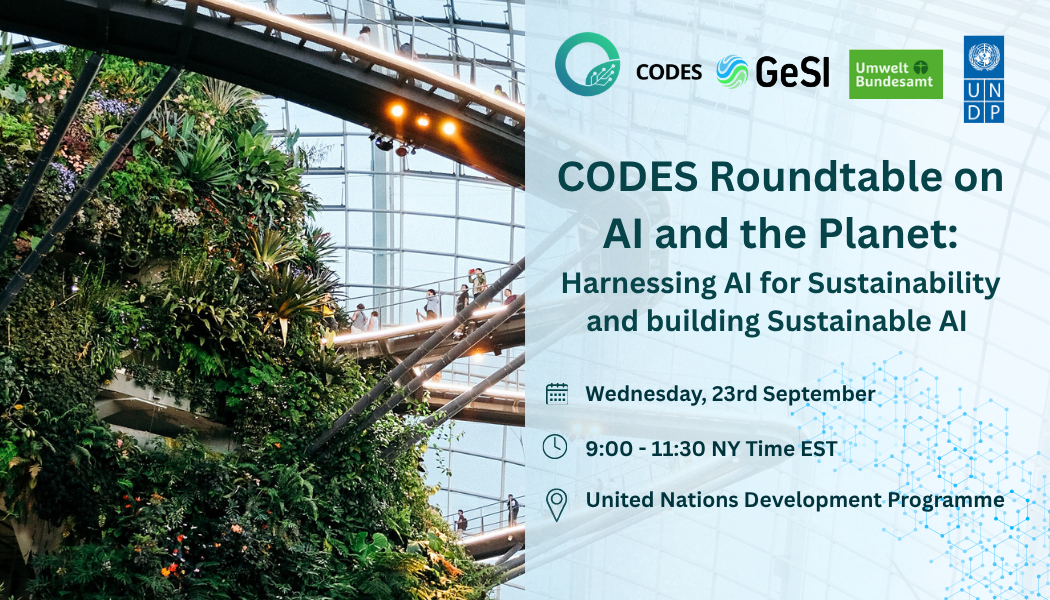
UNGA 2026: CODES Roundtable on AI and the Planet


Harnessing AI for Sustainability and Building Sustainable AI
Digital technologies, infrastructure, and radical breakthroughs such as artificial intelligence (AI) are increasingly critical to addressing the planetary crisis encompassing climate change, biodiversity loss, and air pollution. Yet, the same digital products, services, and ‘digital way of life’ that are now integral to economic prosperity, service delivery, and communication for billions of people are also exacerbating environmental risks like global warming, increasing energy demand, and freshwater shortage because of the natural resource-intensive value chain of the digital ecosystem, ranging from the insatiable demand and ‘race to the bottom’ for raw material like the minerals that power semiconductors to the huge quantities of electricity and water that are required to run and ‘cool’ the data centers. The International Energy Agency forecasts global annual energy demand for data centers to more than double to 945 TWh by 2030. Energy. There is growing recognition that environmentally sustainable AI extends beyond reducing energy use and emissions. It also requires addressing the broader environmental footprint of AI, including water and material consumption, while ensuring that AI delivers inclusive, equitable, and sustainable development outcomes.
Despite growing awareness and the emergence of methodologies to measure and reduce AI's environmental footprint, there remains a significant gap in translating these approaches into systematic, large-scale action. Closing this gap will require stronger AI governance, digital public infrastructure, and strengthening accountability, transparency, and reporting. This is an urgent task that requires collective action by all key stakeholders: governments, development partners, businesses, civil society institutions, academia, Indigenous Peoples, and local communities. This year marks the 2nd anniversary of the adoption of the Global Digital Compact (GDC) as an annex to the Pact for the Future.The Global Digital Compact is based on principles such as inclusion, equity, affordability, accessibility, safety, and transparency. Importantly, the Compact includes Sustainability as one of its key principles, acknowledging the potential of digital technologies in advancing environmental sustainability while addressing and minimizing their environmental footprint. Additionally, the Hamburg Declaration on Responsible Artificial Intelligence (AI) for the Sustainable Development Goals (SDGs) emphasizes environmental sustainability and inclusion, with a call to empower developing economies in the AI era. It reflects a growing international consensus that AI and digital innovation need to be leveraged responsibly, inclusively, and sustainably, aligned with the five pillars of the 2030 Agenda for Sustainable Development: people, planet, prosperity, peace, and partnership.
In this context, the Coalition for Digital Environmental Sustainability (CODES), with a network of 16,000+ practitioners around the world, provides a global multistakeholder platform to align digital transformation with environmental sustainability. CODES brings together this work in a portfolio of “three shifts” of Align, Mitigate, and Accelerate to ensure that digitalization contributes to a sustainable and equitable future. This roundtable on the side of the 81st UN General Assembly and the New York Climate Week will convene governments, donors, UN agencies, private sector and Indigenous representatives to discuss country needs, foresight on AI for climate and nature, and partnership pathways toward the upcoming Climate COP31 in Türkiye and beyond.
Objectives of the Roundtable
- To share solution examples and lessons learned on the use of AI for environmental action, especially policy implications and policy levers for governments to consider, such as the importance of Digital Public Infrastructure, data governance, environmental reporting (aligned with the GHG Protocol), green public procurement standards, and circular-by-design approaches to hardware;
- To update on the latest scientific findings, standardization efforts, and policy solutions for directing the AI technology discourse to mitigate the environmental impacts of AI
- To engage industry directly on structural challenges shaping the sector: market concentration in cloud and AI infrastructure, the exposure of digital infrastructure to climate risk, and the persistent gap in comparable environmental data
- To discuss partnership opportunities, concepts, initiatives and identify where industry commitments could complement government and multilateral action ahead of COP31
Speakers
- Dirk Messner, President of the German Environment Agency (UBA)
- Francine Pickup, Deputy Assistant Administrator and Deputy Director (UNDP)
- Luis Neves, CEO, Global Enabling Sustainability Initiative (GeSI)
- Phillip Thigo, Special Envoy for Technology, Kenya (tbc)
- Tomas Lamanauskas, Deputy Secretary-General, ITU (tbc)
- Cassie Flynn, Director Planet Hub UNDP (tbc)
Date: 23rd September 9:00 - 11:00
Venue: United Nations Development Programme
Virtual Link: https://teams.microsoft.com/meet/336961602877605?p=zXlygEVfzNJGlM2wnm