DPI Mission Lab: Workshop Summary


Context & Framing
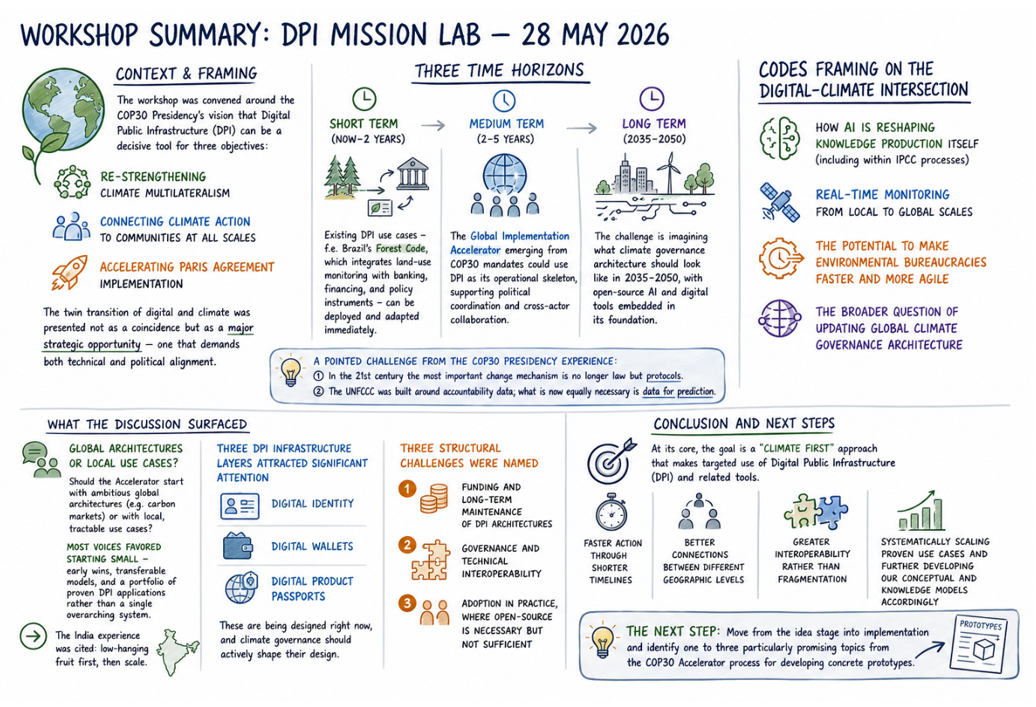
The workshop was convened around the COP30 Presidency's vision that Digital Public Infrastructure (DPI) can be a decisive tool for three objectives: re-strengthening climate multilateralism, connecting climate action to communities at all scales, and accelerating Paris Agreement implementation. The twin transition of digital and climate was presented not as a coincidence but as a major strategic opportunity—one that demands both technical and political alignment.
Three Time Horizons
In the short term, existing DPI use cases — f.e. Brazil's Forest Code, which integrates land-use monitoring with banking, financing, and policy instruments—can be deployed and adapted immediately. In the medium term, the Global Implementation Accelerator emerging from COP30 mandates could use DPI as its operational skeleton, supporting political coordination and cross-actor collaboration. Long term, the challenge is imagining what climate governance architecture should look like in 2035–2050, with open-source AI and digital tools embedded in its foundation.
By way of context, the Accelerator is being developed by the COP30 (Brazil) and COP31 (Türkiye and Australia) Presidencies to focus on practical solutions with the highest potential to drive transformative change on a global scale—that is, to trigger the so-called positive tipping points through targeted interventions that catalyse exponential positive change, cascading across economic sectors and segments of society while keeping 1.5°C within reach. It aims to accelerate solutions included in voluntary and collaborative implementation plans (known as Plans to Accelerate Solutions) from the Action Agenda, combining them with existing solutions in technology, finance and capacity-building and bringing together governments, businesses, financial institutions, cities, and civil society through high-level political weaving.
A pointed challenge was raised from the COP30 presidency experience: two mental model shifts are needed. First, in the 21st century, most codification is no longer enshrined in law but in protocols. Second, the UNFCCC was established in 1992 through the assumption that transparency and data are important for accountability; what is now equally necessary is data for prediction.
What the Discussion Surfaced
A recurring discussion ran through the conversation: should the Accelerator start with ambitious global architectures (e.g. carbon markets) or with local, tractable use cases? Most voices favoured starting small — early wins, transferable models, and a portfolio of proven DPI applications rather than a single overarching system. The India experience was cited: low-hanging fruit first, then scale.
Some participants highlighted that resilience of infrastructure demands caring for concept and designing, adding that public value is the most important feature to be agreed upon and that it depends on the way this digital infrastructure is conceived. Openness, interoperability, and modularity are some of the features stressed to try to overcome the opposition between the use-cases approach (“DPI by accident”) and DPI-by-design.
The existing wealth of DPI use cases globally was highlighted as an underused resource that the Accelerator should actively inventory and draw from, rather than starting from scratch. Inventories of existing DPI solutions, would, therefore, be useful as a starting point.
Three DPI infrastructure layers were raised — digital identity, digital wallets, and digital product passports — with the argument that these are being actively designed and regulated right now, and climate governance should shape that process rather than react to it after the fact.
Participants also emphasized the importance of keeping DPI stacks minimal and modular, especially when setting standards for larger markets. Less is sometimes more: overly complex architectures risk losing the very stakeholders — farmers, local governments, small investors — who need to benefit from them. The Forest Code was invoked as a case where the payment logic matters as much as the technology: distributing small amounts to many actors is not always more effective than directing larger flows to those generating the greatest ecosystem value.
A demand-side warning was raised: the discussion risked becoming too supply-driven, focused on what DPI can do rather than what users and policymakers actually need. Connecting the Accelerator's DPI design to real demand — from national governments, local authorities, and communities — was flagged as essential.
Three structural challenges were named: funding and long-term maintenance of DPI architectures; governance and technical interoperability; and adoption in practice, where open-source is necessary but not sufficient.
The question of who builds and maintains inventories of successful DPI deployments — and whether AI could help here as a starting point — was left open but considered urgent.
Finally, several participants argued for broadening the scope: a DPI stack for climate governance should not be designed in isolation from adjacent domains. Energy, biodiversity, and weather data infrastructures are deeply connected and should be included from the outset, opening up new use cases rather than constraining the architecture to climate alone.
Conclusion and Next Steps
At its core, the purpose of using DPI for climate is not about promoting DPI as an end, but rather to promote climate goals. What matters is what we aim to achieve in the long term: speed and scale in climate action through shorter timelines, better connections between different geographic levels, and greater interoperability rather than fragmentation, generating value to outside stakeholders and absorbing related costs. It is also about systematically scaling proven use cases and further developing our conceptual and knowledge models accordingly.
The next step is to build on what already exists, using the Global Implementation Accelerator to connect a landscape that remains fragmented, drawing together tools, actors and resources. The Accelerator will also create the conditions for a wide range of actors to turn proven DPI solutions into action at scale.
The workshop participants can become a network of partners for mutual support on DPI for climate – and in support of the COP30 and COP31 Presidencies in their legal mandate to guide the Global Implementation Accelerator.